

Are Real Animals Used In The Lion King
One of the best sequences in the original version of The Lion King — the 1994 Disney animated classic — involves young Simba the king of beasts cub puffing up his own ego for the benefit of his pal Nala. Simba isn't any ordinary king of beasts, run across. He'southward going to be the king anytime, and that ways he'll never, always have to listen to anybody he doesn't want to.
And Simba merely can't wait to be king. (Everybody sing!)
The song is imaginative and tricky, and it transforms Simba'south preening self-regard into such a hummable earworm that it's like shooting fish in a barrel enough to buy into everything he proclaims. Yeah, he's as blinkered and naive every bit any piddling kid, but boy, he actually tin can't expect to exist king. Won't that exist great for all the residents of the Pridelands?
The Lion King, directed by Roger Allers and Rob Minkoff, uses its "I Just Tin can't Wait to Be Male monarch" sequence to push its storytelling forward. But information technology also uses the sequence to underline some of its visual grammar. In the globe of The Lion Male monarch, the colour of plants will shift when you transition from a dialogue scene to a musical number:
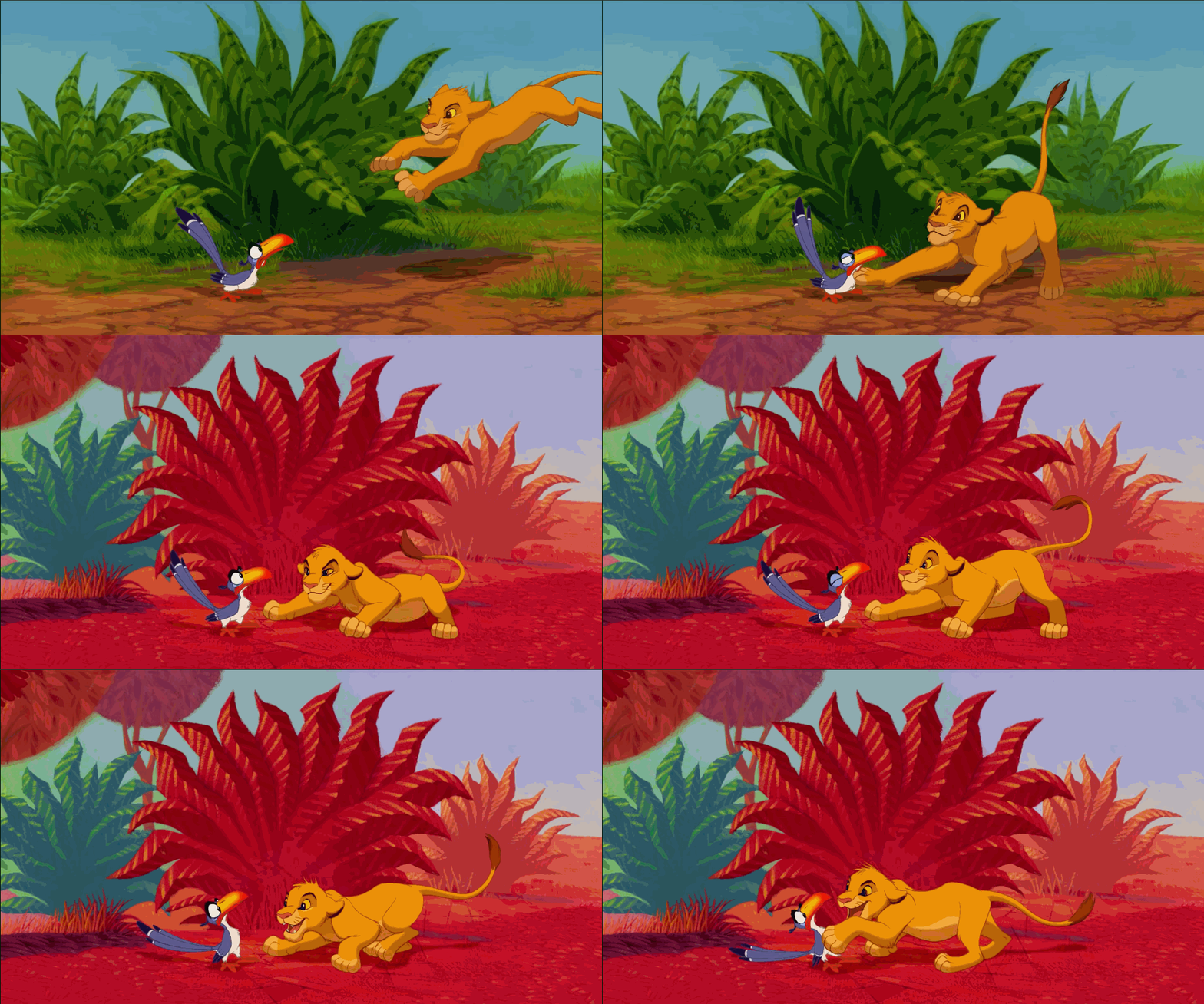
And animals will join in the dance, even if they'd traditionally be your prey:

Its yard finale presents a massive tower of animals, an image straight out of the films of famous musical director Busby Berkeley, and the scene ends with Simba and Nala emerging at the top, perched on the back of an ostrich. The sequence is the picture in a nutshell — colorful, a little silly, and sneakily smart about the characters' maturity levels.

In the new version of The Panthera leo King, director Jon Favreau stages "I Just Tin't Wait to Be King" non equally a kaleidoscope of move and color, but instead as a sequence in which Simba and Nala prance around a waterhole. The vertical and horizontal movements that defined the earlier version are gone; it ends non with a rise column of color and spectacle, just with a bunch of photorealistic jungle animals standing in the waterhole, arranged in a vaguely triangular tableau. It is utterly and completely dispiriting.
It's also the inevitable issue of today'due south film culture. And if you've followed whatever of the ongoing argue nigh whether the new Lion Rex qualifies every bit true "alive action," it encapsulates the proxy argument yous're really listening to: Should "realistic" presentation be a moving-picture show's master goal?
A lot of animation fans are upset with Disney for billing its Lion Male monarch remake as "live activity"
Okay, the extent to which this is a "debate" is a little overstated. The people who care most securely about how the new Panthera leo Rex'south filmmaking is classified are blitheness fans who also participate in Film Twitter, many of whom are frustrated that the remake has abandoned the bright and lively style of the original picture show in favor of an endless stretch of bland and boring beige.
"what if for the big funny vocal the animals walked around then they walked effectually some more than?? and did no other things?" https://t.co/iuCKBxIp0Z
— David Sims (@davidlsims) July 11, 2019
My review of The Lion Rex 2019: watch Planet Earth II in 4k
— Lindsay Ellis (@thelindsayellis) July 17, 2019
The King of beasts King (2019): The cinematic equivalent of sitting in traffic.
— Emily VanDerWerff (@tvoti) July 11, 2019
But the question remains: Should nosotros call this new Lion King "animated" or "live action"?
To picket the picture show is to exist enlightened of how information technology's trying to await like live-action. Everything about its visual furnishings is meant to appear equally photorealistic every bit possible, to the caste that Disney did not even use motion-capture techniques to match the facial expressions of its computer-blithe animals to those of the performers who voiced them (every bit it did with 2016's The Jungle Book, the earlier Disney remake directed past Jon Favreau). And as these things go, the animals do look realistic. Indeed, they look then real that they kept triggering my sense of the uncanny valley (when something fake looks so real that we only become more enlightened of how fake it is), specially when they were talking and their mouths mostly stayed rigid, and then they could flap but a scrap and create the illusion of "speaking."
In interviews, the creative squad behind the new Lion King — in repeated attempts to justify its beingness — has talked well-nigh the 1994 pic reverentially, while as well seeming to completely misunderstand what made it good or why it would e'er require updating. Favreau has gone so far every bit to compare his new picture to a restoration of an architectural marvel, bringing it back to its original glory, which only makes sense if you believe that photorealism is de facto amend than something more than fantastical.
Just Disney's billing of the new Lion King as "live action" only obscures why the movie is such a creative failure. Because of course information technology's animated! Every single one of its characters was built in a reckoner somewhere, and just because the whole thing has the aesthetic of a 4K TV exam demo doesn't mean it's alive-activeness. The new Lion King isn't even like the 1995 picture Babe, where existent animals were filmed so animators used computers to make it seem like they could speak. It is an utter fabrication. The characters are, in effect, animated puppets.
And because nobody involved in the film seems interested in labeling it as "animation," the movie fails because it doesn't conceptualize the most bones and obvious challenge of reckoner blitheness: It's really freaking hard to create full, emotive performances driven by facial expressions instead of vocalism acting. It's non impossible — surely, you've seen a Pixar picture show! — merely it's tougher than in hand-drawn animation.
3D estimator blitheness is proficient at many things. Information technology is not particularly good at beingness "cartoony."
:format(webp):no_upscale()/cdn.vox-cdn.com/uploads/chorus_asset/file/3821022/InsideOut556500e6a2be0.0.jpg)
The original Lion King is the very definition of a style that animation fans would refer to as "cartoony." Information technology has bright colors that pop. Information technology has funny sight gags and slapstick. And its characters' torso language and facial expressions are controlled on a frame-past-frame level, giving them a hyperreal sense of emotion that even a human being actor couldn't convey. Cartoon faces and bodies tin change shape or size — sometimes subtly and sometimes very obviously — to emphasize a story indicate.
The original Lion Rex is as well a production of the era when computers were just starting to get a common tool of blitheness, in specific applications. The wildebeest stampede that kills Mufasa was largely created in a computer, merely Simba and Mufasa were blithe by mitt so layered atop the computer-generated stampede. The movie'southward animators relied on a figurer to handle something computers are very good at — creating an overwhelming sense of hundreds upon hundreds of creatures rushing at the screen — while using traditional animation to shepherd the scene'south emotional core. That split up between the two methods is primal, and a big reason the stampede scene works so well.
In the 21st century, almost all animation is done on computers, merely there's all the same a stardom between characters that are "fatigued" (even if the pen is digital) and characters that are "modeled." Characters that are drawn tend to accept the familiar 2D wait of the Disney classics. For a great recent instance, bank check out this prune from 2014's Song of the Sea — the movie was created in a estimator, simply animators "drew" the characters and backgrounds, so it has the feel of traditional animation (though information technology is necessarily more minimalist than traditional hand-drawn animation would be).
3D computer blitheness is processed differently. Instead of being drawn by a human being animator, characters are modeled, meaning they are 3D creations built atop computer-created 3D skeletons. They're closer to puppets or end-motility figures than anything else — with joints that bend and limbs that move in certain ways. And that'due south why creating broad facial expressions or changing characters' forms to pull off better gags or more than affecting moments is and so difficult within the format.
What I've laid out to a higher place is an incredibly loftier-level survey of the differences between the 2 approaches. If you desire more details, yous tin read my piece on the Hotel Transylvania franchise, which found a way to blend cartoony style with 3D animation (really!). But hopefully my very brief summary gives you a sense of why the new King of beasts Rex characters tin can't emote similar the old Lion King characters: On a very real level, they simply aren't built to.
Creating photorealistic animals means creating animals that can't issues out their eyes in distress or flash confident smirks or come-here glances, because we know animals in our reality tin can't exercise that. But even if we wanted to create photorealistic animals whose hearts could beat right out of their chests, 3D estimator blitheness makes it very, very hard to practise that in the outset place, which is how y'all finish upward with a moving-picture show where pop songs are performed past animals that mostly walk around during them, instead of doing annihilation involving colour and verve.
That's why the argument over whether this new Lion Male monarch is animated or live-action is sort of a proxy battle over the value of 2nd animation, which has fallen on hard times. Disney hasn't stopped making the original versions of its animated classics available in the way that, say, George Lucas discontinued distribution of the original Star Wars trilogy after the special editions became bachelor in the 1990s. Merely there is a sense that the new flick is the "existent" Lion Rex, and the original sits in its shadow.
And honestly, for the kids of today, maybe that volition exist true. Its nostalgia play volition drag them to the theaters alongside their parents who saw the original when they were kids, and in time, the original Panthera leo King will be but a curio. Fears of that possible future are what'southward driving many of the animation fans who are pushing dorsum against this movie and Disney's remake projects more generally.
But I think the new King of beasts King will speedily sink from view, while the original remains a beloved classic. And the reasons have nearly nil to practice with Disney or remakes at all.
Likewise much of our current popular culture is driven past an obsession with realism. Only that's jump to change.
:format(webp):no_upscale()/cdn.vox-cdn.com/uploads/chorus_asset/file/16212968/_18__Courtesy_of_HBO.jpg)
Let'south forget about Disney for a 2nd to talk over a different ascendant pop culture strength: HBO.
HBO congenital its reputation on shows that took very traditional, trope-y forms and so found means to subvert them, celebrating the tropes while also exploring some of their darker sides. A mob story might be infused with psychological realism (The Sopranos). A romantic comedy might acknowledge that any number of people could exist "the one" (Sex and the City). A fantasy series might admit that a truly proficient king can never exist (Game of Thrones).
As a result, many people have the sense that HBO's shows, which are often very good, are somehow more sophisticated, too. That'southward how you get to the idea that something like Game of Thrones is fantasy for people who don't like fantasy, or "for adults," or whatever you lot want to call information technology. And that's fine! Any genre or storytelling form should have room for both its most realistic cocky and its most fantastical self. There'south plenty of room in the fantasy genre for the more serious Game of Thrones and the more whimsical Chronicles of Narnia, equally well as something similar The Magicians, which is an attempt to undercut both through something more humorous or fifty-fifty satirical.
The problem is that companies similar Disney and HBO are tilting ever more heavily toward the "realism" side of things, even when a story doesn't necessarily need to be presented realistically. And so far, Disney's live-activeness remakes have mostly eschewed whimsy in favor of stories that attempt to mankind out the originals' flimsy world-building, to ameliorate marshal with vaguely progressive 2019 politics, to cover up supposed plot holes, or fifty-fifty just to tug the story away from a G rating and toward PG or fifty-fifty PG-xiii.
But most stories are flimsy scaffolds, and the 2nd you get-go messing with them too much, the audience's suspension of disbelief collapses. The new Lion King has such surprisingly extensive thoughts on the policy differences between Mufasa and Scar that it led me to ask oodles of questions most how the world of The Panthera leo King works, questions that never would have come up in the original. (A big 1: So ... do the lions, similar, schedule their hunts and let the antelope know, or ... ?) YouTube essayist Lindsay Ellis has a video nearly Dazzler and the Beast's 2017 remake that similarly makes this point.
Where does this obsession with realism come up from, though? Well, it has at least something to exercise with our online discourse effectually pop culture, discourse that'south driven in role by websites similar this one. A movie or story can never be just a motion picture or story; it's besides an opportunity to talk nearly what that movie or story "gets wrong" or how it messes up some political or sociocultural story point. It's an opportunity to, more or less, fact-check fiction.
Sometimes this impulse is valuable — and even more than often, it's a lot of fun. Do I desire to know the likelihood of the events of a sci-fi film similar The Martian or Gravity really happening? Sure! That sounds entertaining! And do I want to hear about how whatever given movie might play into a harmful trope that bedevils a group traditionally underrepresented in media? Of course. As a critic and a storyteller, I want to better understand how people who are very unlike from me perceive the stories we tell, particularly in a culture where most stories are still told by straight white cisgender men.
Merely it'southward easy to cantankerous a dangerous line between "talking about something that's wrong with a work" and "piling on because the cyberspace has made it seem similar criticism is piling on." Consider YouTube channels similar CinemaSins, which count down "mistakes" in movies for supposed comedic effect only mostly create pointless lists of nitpicks that suggest a picture show is only as expert as it is completely flawless. (For a much more forceful have on this topic, come across YouTuber Sarah Z.)
The problem is that stories aren't flawless. Stories aren't real, either. They are, by their very nature, blinkered by the perspectives of those who wrote them. They exist to be problematic because they reverberate a problematic world. And they all have plot holes, because it's incommunicable to create a 100 percent airtight plot. Reality has plot holes, besides. How else do you explain all of this? [gestures to entirety of the universe]
The all-time filmmakers find ways to ensure you'll miss the plot holes or the problematic elements of their stories at least until later on you've exited the theater and started mulling over what y'all saw. Aye, we can find issues in the original version Beauty and the Beast and The King of beasts Rex if we poke at them long enough. But you tin notice problems in any story if y'all poke at it long enough.
The conversations effectually both of those movies are valuable, and so is finding problems in them. Only it doesn't devalue the original Lion King if I point out that it's not articulate how Rafiki determines Simba is alive, because he's a magic baboon priest. You can merely sort of presume he has a vision or something! The new movie takes groovy pains to explain how he figures it out, and the effort only grinds everything to a halt. Sometimes a supposed plot pigsty is a asking to the audience to take a leap of faith.
Today'due south bizarre practice of nostalgia culture reanimating all of the hits of the '80s and '90s in a world that demands they be fabricated more than "realistic" to appeal to "adults" is bound to end at some signal. There volition eventually exist a difficult snap back to the fantastical, because there always is. Storytelling trends are as cyclical as anything else, and people volition eventually become sick of all this nostalgia poison. Just until then, it'south worth thinking about what information technology means that The Lion King is billed as "live action" and "existent" when it'due south annihilation but. It's worth asking why those characteristics should have value but something colorful and fanciful and meant for kids and ameliorate should not.
Source: https://www.vox.com/culture/2019/7/19/20692319/lion-king-new-live-action-animated-debate-2d-3d
Posted by: weissfroned.blogspot.com
0 Response to "Are Real Animals Used In The Lion King"
Post a Comment