

How Many Pairs Of Chromosomes In A Normal Animal Cell? 23 Pairs 36 Pairs 18 Pairs 28 Pairs
Prison cell Reproduction
50 Cell Division
Learning Objectives
By the stop of this section, you will be able to practise the following:
- Describe the structure of prokaryotic and eukaryotic genomes
- Distinguish between chromosomes, genes, and traits
- Describe the mechanisms of chromosome compaction
The continuity of life from one cell to some other has its foundation in the reproduction of cells by manner of the cell cycle. The cell cycle is an orderly sequence of events that describes the stages of a prison cell's life from the sectionalisation of a unmarried parent cell to the production of ii new genetically identical daughter cells.
Genomic Deoxyribonucleic acid
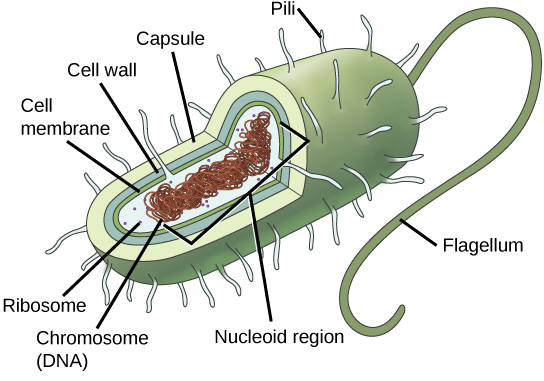
Before discussing the steps a jail cell must undertake to replicate and divide its Dna, a deeper agreement of the structure and function of a cell's genetic data is necessary. A jail cell'southward Dna, packaged as a double-stranded Deoxyribonucleic acid molecule, is called its genome. In prokaryotes, the genome is composed of a unmarried, double-stranded DNA molecule in the form of a loop or circle ((Figure)). The region in the cell containing this genetic material is called a nucleoid. Some prokaryotes also have smaller loops of DNA called plasmids that are not essential for normal growth. Bacteria can exchange these plasmids with other bacteria, sometimes receiving benign new genes that the recipient can add to their chromosomal DNA. Antibiotic resistance is i trait that ofttimes spreads through a bacterial colony through plasmid substitution from resistant donors to recipient cells.
Prokaryotes, including both Bacteria and Archaea, have a single, circular chromosome located in a central region called the nucleoid.
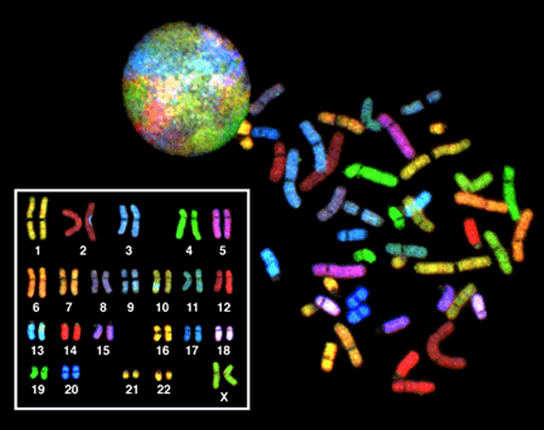
In eukaryotes, the genome consists of several double-stranded linear Deoxyribonucleic acid molecules ((Effigy)). Each species of eukaryotes has a characteristic number of chromosomes in the nuclei of its cells. Homo body (somatic) cells have 46 chromosomes, while human gametes (sperm or eggs) have 23 chromosomes each. A typical torso prison cell contains 2 matched or homologous sets of chromosomes (1 set from each biological parent)—a configuration known equally diploid. (Annotation: The letter n is used to represent a single ready of chromosomes; therefore, a diploid organism is designated 2due north.) Man cells that contain ane set of chromosomes are called gametes, or sex cells; these are eggs and sperm, and are designated 1n, or haploid.
Upon fertilization, each gamete contributes one fix of chromosomes, creating a diploid cell containing matched pairs of chromosomes called homologous ("same knowledge") chromosomes. Homologous chromosomes are the same length and have specific nucleotide segments called genes in exactly the same location, or locus. Genes, the functional units of chromosomes, determine specific characteristics by coding for specific proteins. Traits are the variations of those characteristics. For example, hair color is a characteristic with traits that are blonde, brown, or black, and many colors in between.
There are 23 pairs of homologous chromosomes in a female human somatic cell. The condensed chromosomes are viewed within the nucleus (acme), removed from a cell during mitosis (also called karyokinesis or nuclear partition) and spread out on a slide (correct), and artificially arranged according to length (left); an organisation like this is called a karyotype. In this epitome, the chromosomes were exposed to fluorescent stains for differentiation of the different chromosomes. A method of staining called "chromosome painting" employs fluorescent dyes that highlight chromosomes in unlike colors. (credit: National Human Genome Project/NIH)
Each copy of a homologous pair of chromosomes originates from a different parent; therefore, the different genes (alleles) themselves are not identical, although they code for the aforementioned traits such as "hair color." The variation of individuals within a species is due to the specific combination of the genes inherited from both parents. Even a slightly altered sequence of nucleotides inside a factor can result in an alternative trait. For instance, there are three possible gene sequences on the human being chromosome that code for blood type: sequence A, sequence B, and sequence O. Because all diploid homo cells have two copies of the chromosome that determines claret blazon, the blood type (the trait) is determined by the two alleles of the marker cistron that are inherited. It is possible to have two copies of the same factor sequence on both homologous chromosomes, with i on each (for example, AA, BB, or OO), or ii dissimilar sequences, such equally AB, AO, or BO.
Obviously minor variations of traits, such equally blood blazon, middle color, and handedness, contribute to the natural variation establish within a species, but even though they seem small-scale, these traits may be connected with the expression of other traits as of yet unknown. However, if the entire DNA sequence from whatsoever pair of man homologous chromosomes is compared, the divergence is much less than 1 percent. The sex activity chromosomes, Ten and Y, are the single exception to the rule of homologous chromosome uniformity: Other than a small-scale amount of homology that is necessary to accurately produce gametes, the genes found on the Ten and Y chromosomes are different.
Eukaryotic Chromosomal Structure and Compaction
If the DNA from all 46 chromosomes in a man cell nucleus were laid out finish-to-cease, it would measure approximately ii meters; all the same, its diameter would be merely ii nm! Because that the size of a typical human being prison cell is about x µm (100,000 cells lined up to equal one meter), Deoxyribonucleic acid must be tightly packaged to fit in the cell'due south nucleus. At the same time, it must also be readily attainable for the genes to be expressed. For this reason, the long strands of DNA are condensed into meaty chromosomes during certain stages of the jail cell bicycle. There are a number of ways that chromosomes are compacted.
In the start level of compaction, short stretches of the DNA double helix wrap around a core of 8 histone proteins at regular intervals forth the entire length of the chromosome ((Effigy)). The DNA-histone circuitous is called chromatin. The beadlike, histone DNA circuitous is chosen a nucleosome, and DNA connecting the nucleosomes is called linker Deoxyribonucleic acid. A Deoxyribonucleic acid molecule in this form is about vii times shorter than the double helix without the histones, and the beads are about 10 nm in diameter, in dissimilarity with the 2-nm diameter of a DNA double helix.
The second level of compaction occurs as the nucleosomes and the linker Deoxyribonucleic acid between them roll into a thirty-nm chromatin fiber. This coiling further condenses the chromosome so that it is now near l times shorter than the extended form.
In the tertiary level of compaction, a diverseness of gristly proteins is used to "pack the chromatin." These fibrous proteins also ensure that each chromosome in a non-dividing cell occupies a particular surface area of the nucleus that does not overlap with that of whatever other chromosome (encounter the top image in (Figure)).
Double-stranded Deoxyribonucleic acid wraps effectually histone proteins to form nucleosomes that create the appearance of "chaplet on a string." The nucleosomes are coiled into a thirty-nm chromatin fiber. When a cell undergoes mitosis, the chromosomes condense even further.
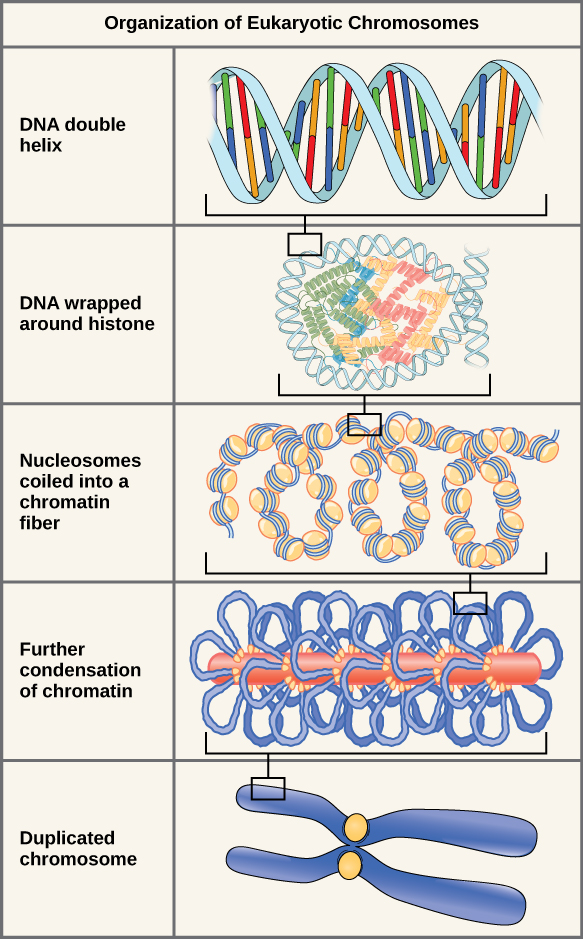
Deoxyribonucleic acid replicates in the S phase of interphase, which technically is non a part of mitosis, only must always precede it. After replication, the chromosomes are equanimous of two linked sis chromatids. When fully compact, the pairs of identically packed chromosomes are spring to each other by cohesin proteins. The connection between the sis chromatids is closest in a region called the centromere. The conjoined sister chromatids, with a bore of about 1 µm, are visible nether a light microscope. The centromeric region is highly condensed and thus will announced every bit a constricted expanse.
Link to Learning
This animation illustrates the dissimilar levels of chromosome packing.
Section Summary
Prokaryotes have a single circular chromosome composed of double-stranded Deoxyribonucleic acid, whereas eukaryotes have multiple, linear chromosomes composed of chromatin wrapped around histones, all of which are surrounded by a nuclear membrane. The 46 chromosomes of human somatic cells are composed of 22 pairs of autosomes (matched pairs) and a pair of sex chromosomes, which may or may not be matched. This is the 2due north or diploid state. Human gametes take 23 chromosomes, or one complete ready of chromosomes; a prepare of chromosomes is complete with either one of the sex chromosomes, 10 or Y. This is the due north or haploid state. Genes are segments of DNA that code for a specific functional molecule (a protein or RNA). An organism'south traits are determined by the genes inherited from each parent. Duplicated chromosomes are composed of two sis chromatids. Chromosomes are compacted using a variety of mechanisms during certain stages of the jail cell cycle. Several classes of protein are involved in the organization and packing of the chromosomal Dna into a highly condensed structure. The condensing complex compacts chromosomes, and the resulting condensed structure is necessary for chromosomal segregation during mitosis.
Review Questions
A diploid cell has_______ the number of chromosomes as a haploid cell.
- one-quaternary
- half
- twice
- 4 times
C
An organism'south traits are determined by the specific combination of inherited _____.
- cells.
- genes.
- proteins.
- chromatids.
B
The first level of Dna arrangement in a eukaryotic cell is maintained by which molecule?
- cohesin
- condensin
- chromatin
- histone
D
Identical copies of chromatin held together by cohesin at the centromere are called _____.
- histones.
- nucleosomes.
- chromatin.
- sister chromatids.
D
Critical Thinking Questions
Compare and contrast a human somatic cell to a human gamete.
Human somatic cells have 46 chromosomes: 22 pairs and 2 sexual practice chromosomes that may or may not form a pair. This is the iin or diploid condition. Man gametes have 23 chromosomes, one each of 23 unique chromosomes, ane of which is a sex activity chromosome. This is the n or haploid condition.
What is the relationship between a genome, chromosomes, and genes?
The genome consists of the sum total of an organism's chromosomes. Each chromosome contains hundreds and sometimes thousands of genes, segments of DNA that code for a polypeptide or RNA, and a big amount of DNA with no known function.
Eukaryotic chromosomes are thousands of times longer than a typical cell. Explain how chromosomes can fit inside a eukaryotic nucleus.
The DNA double helix is wrapped around histone proteins to form structures called nucleosomes. Nucleosomes and the linker Deoxyribonucleic acid in betwixt them are coiled into a 30-nm fiber. During jail cell partition, chromatin is further condensed by packing proteins.
Glossary
- cell bicycle
- ordered sequence of events through which a jail cell passes between one cell division and the next
- centromere
- region at which sister chromatids are jump together; a constricted area in condensed chromosomes
- chromatid
- single Dna molecule of 2 strands of duplicated Deoxyribonucleic acid and associated proteins held together at the centromere
- diploid
- cell, nucleus, or organism containing ii sets of chromosomes (2north)
- gamete
- haploid reproductive prison cell or sexual activity cell (sperm, pollen grain, or egg)
- gene
- concrete and functional unit of heredity, a sequence of Deoxyribonucleic acid that codes for a protein.
- genome
- total genetic information of a jail cell or organism
- haploid
- jail cell, nucleus, or organism containing one set of chromosomes (n)
- histone
- 1 of several similar, highly conserved, low molecular weight, basic proteins found in the chromatin of all eukaryotic cells; assembly with DNA to form nucleosomes
- homologous chromosomes
- chromosomes of the same morphology with genes in the same location; diploid organisms accept pairs of homologous chromosomes (homologs), with each homolog derived from a different parent
- locus
- position of a cistron on a chromosome
- nucleosome
- subunit of chromatin composed of a short length of DNA wrapped around a cadre of histone proteins
Source: https://opentextbc.ca/biology2eopenstax/chapter/cell-division/
Posted by: weissfroned.blogspot.com
0 Response to "How Many Pairs Of Chromosomes In A Normal Animal Cell? 23 Pairs 36 Pairs 18 Pairs 28 Pairs"
Post a Comment